

How often have we seen the terms eco-friendly, recyclable, compostable and energy-efficient been used for the promotion of products on spurious environmental grounds?
Purpose of Environmental Statements
Communicating the environmental aspects and potential environmental impacts of products assists intended audiences (e.g. investors, purchasers, consumers) to make decisions on the selection and use of those products. The overall objective of providing information about the environmental aspects and associated impacts of products (i.e., environmental statements) is to encourage the selection, purchase, and use of those products that have the least adverse potential or actual environmental impact.
Suppliers that communicate the environmental aspects and environmental impacts of their products via environmental statements hope to influence the market in favour of their products. If successful, the market share of those products can increase, and it is possible that other suppliers will respond by improving the environmental performance of their products. Ultimately, this can result in reduced environmental impact from that product category.
Suppliers can also realise product development benefits as well as improvement in their overall environmental performance.
The ISO 14020 Family of Standards
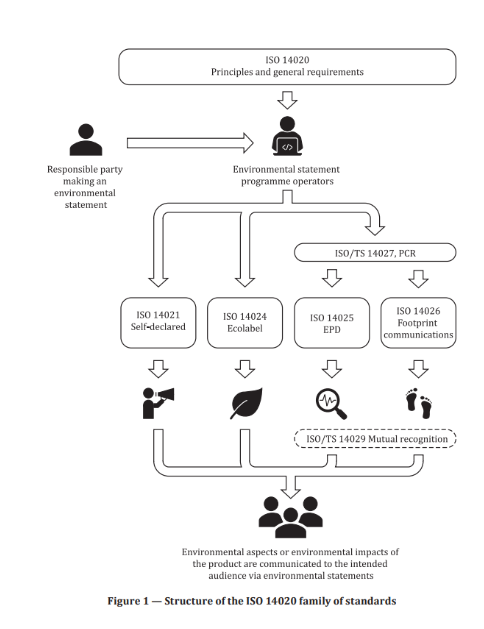
The ISO 14020 family of standards provide principles and requirements for communicating environmental aspects and environmental impacts of products through environmental statements such as:
- self-declared environmental claims (ref. ISO 14021);
- ecolabels (ref. ISO 14024);
- environmental product declarations (EPDs) (ref. ISO 14025);
- footprint communications (ref. ISO 14026)
Three of these standards – ISO 14021, ISO 14024 and ISO 14025 were updated in 2026.
ISO 14021:2026: Environmental statement and programmes for products – self-declared environmental claims was published in June 2026 with the purpose of providing a structured approach for developing and managing self-declared environmental claims across packaging, labels, advertising, product literature and digital channels. This third edition cancels and replaces the second edition, ISO 14021:2016.
Environmental claims can help customers to make informed selections – but only when those claims are clear, credible and supported by reliable evidence. Therefore, a welcome update in the 2026 edition of ISO 14021 is the requirement for claims to be part of a documented environmental statement programme. This helps organisations ensure that every claim is supported by defined criteria, appropriate evidence and clear internal responsibilities.
Self-declared environmental claims are just one type of environmental statement, promulgated under the aegis of ISO 14020:2022, which provides common terms and definitions and the general requirements for all environmental statements (e.g. self-declared environmental claims, ecolabels, EPDs and footprint communications).
Key Definitions Found
ISO 14020:2022 defines an environmental statement as ” information on one or more environmental aspect(s) or environmental impact(s) of a product intended to inform and influence the market of the product”.
ISO 14021:2026 defines a self-declared environmental claim as ” an environmental statement that is made outside of any third-party environmental statement programme by the supplier of the product, or by any other party likely to benefit from the supply of the product to the user”. A self-declared environmental claim on a product is provided by an organisation which is involved in the supply or the marketing of this product and wants to demonstrate specific positive environmental aspects of this product in order to influence the market.
ISO 14024:2026 defines an ecolabel as “an environmental statement that indicates a product fulfils the requirements of an ecolabelling programme”. An ecolabel on a product indicates overall environmental preferability of that product within a particular product category, based on meeting multiple criteria that are based on life cycle considerations. A licence to use an ecolabel is awarded through an independent, voluntary programme operated by a party that is not associated with the supply of the product.
ISO 14025:2026 defines an environmental product declaration (EPD) as ” an environmental statement providing environmental data of a product using predetermined impact indicators and predetermined inventory indicators resulting from a life cycle assessment (LCA) and, where relevant and available, additional environmental information”. The predetermined parameters address relevant impacts and are derived from LCA using product category rules (PCR).
ISO 14026:2017 defines a footprint as ” a metric(s) used to report life cycle assessment results addressing an area of concern”. A footprint communication provides one or more metric(s) related to a specific area of concern, e.g. climate change (carbon footprint communication) or water scarcity (water footprint communication).
Environmental statements are made based on a statement programme that conforms to Table 1 taken from ISO 14040:2022.
Requirements for Environmental Statement Programmes
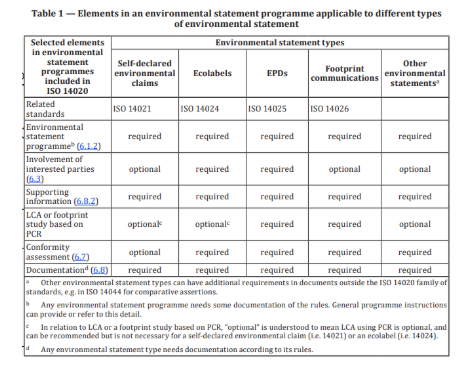
Environmental statement programmes must specify the following:
- programme owner and programme operator (if the programme owner is not the operator);
- type of environmental statement;
- extent to which interested parties are involved in the development and operation of the programme;
- scope of the programme, including the subject matter of the environmental statement and any related International Standard, responsible parties and intended audiences;
- specified requirements and criteria that the subject matter fulfils in order for the environmental statement to be credible;
- definition of data to be used and quantification methodologies, including data quality criteria and reporting;
- impartiality, competency and the extent of independence of the person and/or body undertaking any conformity assessment activities, including determination processes, and any subsequent review and decision-making;
- format of the environmental statement, and any reporting and publication requirements;
- process for implementing changes to programme, specified requirements and criteria, or the environmental statement.
Benefits of Environmental Statements
The benefits of publishing bona fide environmental statements include:
- accurate, relevant, and verifiable environmental claims that are not misleading;
- increased potential for market forces to stimulate and improve environmental aspects in production, processes and products;
- prevention or minimisation of unwarranted claims and greenwashing;
- less marketplace confusion;
- facilitation of international trade;
- increased opportunities for purchasers and users of a product to make better-informed choices.